
Family Dining · Practical guide
Kyukyodo
The Inbound Traveler's Guide to Japan's 360-Year-Old Incense, Washi Paper & Calligraphy Heritage
Prices, ordering steps, payment details, and common mistakes — in one place.
Quick Facts
| Category | Detail |
|---|---|
| Japanese name | 鳩居堂 (Kyukyodo) |
| Brand Name | Kyukyodo / 鳩居堂 (株式会社鳩居堂 / Kyukyodo Co., Ltd.) |
| Store Type | Historic artisanal incense atelier, handmade Japanese washi emporium & traditional calligraphy heritage boutique |
| Target Audience | Cultural travelers, mindfulness and meditation practitioners, calligraphers, collectors of traditional Japanese papercraft, and gift shoppers seeking refined souvenirs |
| Ordering Style | Browse washi stationery, incense and calligraphy materials on the public retail floors; ask staff whether a particular incense can be sampled before opening or lighting it. |
| Membership Required? | No membership or local registration required for general shopping; open to all visitors |
| Approximate Price Range | Incense, washi postcards, brushwork supplies and gift packages range from small everyday purchases to high-priced specialty pieces. Exact retail prices and the availability of rare agarwood or antique stock vary; no tourist tax-free registration at the named Ginza/Kyoto shops was independently confirmed. |
| Multilingual Support | Visitors can use the official store information, but specific English fragrance cards or bilingual specialist coverage at each floor have not been verified. |
| Payment Methods | Cash and store-accepted credit/electronic methods; acceptance of particular international card brands, IC cards and QR wallets must be checked at the branch. |
| Store Network | A small domestic network across Tokyo, Kyoto, and Kanagawa in Japan (per the official store guide: Kyoto Main Store in Teramachi and Tokyo Ginza Main Store at Ginza 5-Chome, with Tokyo branches in Shibuya (Shibuya Scramble Square), Shinjuku and Ikebukuro, and a Yokohama branch inside SOGO Yokohama) |
What it is
Founded in 1663 (Kanbun 3) as a medicinal-herb merchant in front of Honno-ji Temple in Kyoto, Kyukyodo took its name from a classical Chinese poem and the Kumagai family crest. Incense production began in the eighteenth century, alongside Chinese-imported writing materials. In 1877, Prime Minister Sanjo Sanetomi transmitted to eighth-generation head Kumagai Naoyuki a tradition of imperial-court incense formulas; this historical connection remains part of Kyukyodo’s identity.
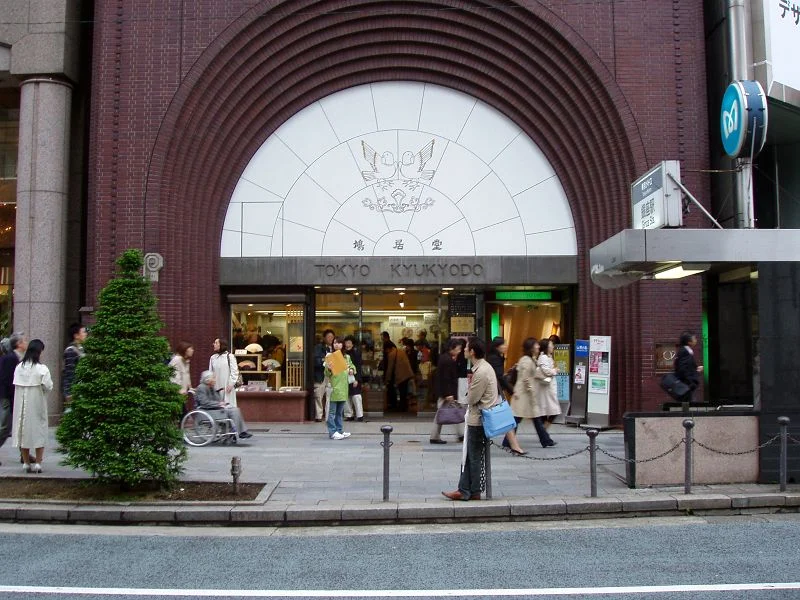
In Tokyo, Kyukyodo Ginza stands at Ginza 5-7-4, with stationery and washi paper on 1F, incense and brushwork supplies on 2F, and exhibition galleries on 3F–4F. Its incense, brushes, ink and seasonal cards remain the reason to visit; visitors should not expect brush retail counters on the upper gallery floors.
How to order
Step 1: Visiting the Ginza or Kyoto Flagship
Kyukyodo's flagship locations provide an atmospheric gateway into classical Japanese culture:
- Tokyo Kyukyodo Ginza Main Store: Situated on the premier corner of Ginza Chuo-dori (Ginza 5-Chome).
- 1F Traditional Washi & Greeting Goods: Displays hundreds of seasonal postcards painted with Japanese nature motifs, decorative cash envelopes (Shugi-bukuro), paper fans, and stationery.
- 2F Traditional Incense & Aromatic Heritage: The fragrant sanctuary where natural agarwood, sandalwood, and incense burners are showcased.
- 3F & 4F Gallery Floors: Exhibition/gallery areas rather than permanent brush and inkstone retail departments; consult the ground and second floors for purchases.
- Kyoto Kyukyodo Main Store: Located in Teramachi-dori, Kyoto, retaining classical architectural charm and centuries of local heritage.
- Hours: Ginza Main Store 11:00 AM–7:00 PM; Kyoto Main Store 10:00 AM–6:00 PM. Special closures and year-end hours are listed separately by Kyukyodo.
Step 2: Sampling Fragrances with Staff Guidance
- Kyukyodo's fragrance staff are steeped in the traditional art of Japanese incense.
- Understanding Core Scent Families:
- Byakudan (Sandalwood / 白壇): Warm, woody, soothing, and subtly sweet; ideal for everyday home relaxation and meditation.
- Jinko (Agarwood / 沈香): Deep, resinous, complex, and earthy; harvested from naturally resin-infused aged timber.
- Kyara (伽羅): The highest grade of agarwood; an extraordinarily precious natural aromatic with balsamic, floral, and sacred undertones.
- Ask whether a particular incense has a sample or demonstration; live burning or heated trays are not guaranteed as a standard service.
Step 3: Cashier Checkout & Gift Presentation
- Proceed to the staffed checkout counters.
- Ask the shop whether gift wrapping is available and what it costs; do not assume a particular named traditional wrapping style, crest or colored cord will be provided for every purchase.
Step 4: Tax-Free Refund Counter Procedure
- Branch tax-free status: Tourist tax-free service has not been independently verified for the branch named in this guide. Ask the store to confirm its current authorization and eligible items before planning a refund; do not assume that displaying a chain name establishes tax-free status.
- Inform the attendant: "Tax-Free kudasai" and present your original physical foreign passport (Temporary Visitor status required).
- Under Japan's airport refund tax-free mechanism (enacted November 1, 2026):
- Pay the full tax-inclusive price. A refund applies only at an authorized shop for an eligible visitor and purchase.
- Only if this specific branch is an authorized tax-free shop, ask staff to register your eligible passport and purchase electronically. A chain name or shopping-mall location does not itself guarantee enrollment.
- Eligible purchase and export: Since November 1, 2026, the former separate statutory categories of “general goods” and “consumables” no longer apply. At an authorized tax-free shop, an eligible visitor must spend at least ¥5,000 excluding tax in total at the same shop on the same day. Eligible goods covered by the purchase record must be taken out of Japan, not consumed or used up in Japan.
- 90-Day Customs Verification: Complete Japan Customs departure verification within 90 days after purchase. Use the required passport and electronic customs procedure; Customs may request an inspection of the goods. Where a check is needed for goods packed in checked baggage, do it before surrendering the bag.
- Baggage and Customs: Protect fragile ceramics and glass ink bottles against breakage. For international carry-on, ordinary nonhazardous liquids must fit the applicable 100-ml-container rules; large bottles may need checked baggage, while hazardous liquids may be forbidden entirely. Check the product and airline rules. If Customs needs to inspect items in checked luggage, do this before baggage drop.
- Refund Execution: After Customs confirms export, the authorized retailer or its designated refund provider returns the applicable tax by the registered refund method. Customs does not pay the refund at the airport. The former immediate point-of-sale exemption and special consumable packaging procedures do not apply to purchases under the new system.
What to order first
1. Traditional Kyukyodo Sandalwood & Floral Incense Sticks
- What it is: Kyukyodo's hallmark natural incense sticks (such as "Shiragiku" White Chrysanthemum, "Miyako-gusa", or "Shin-tokusen Byakudan").
- Why buy it: Kyukyodo offers traditional incense with sandalwood, agarwood and other aromatic materials as well as modern fragrance formulations; ingredients vary by product. Check the specific incense label rather than assuming every item is free of modern fragrance compounds.
- Price expectation: Approximately ¥1,200 to ¥3,500 per boxed set.
2. Silk Brocade Fragrant Wardrobe Sachets (Nihoi-bukuro / にほひ袋)
- What it is: Small, colorful pouches sewn from antique Kyoto Nishijin silk brocade filled with aromatic camphor, clove, cinnamon, and sandalwood powders.
- Why buy it: Hang them in your closet, slip them into clothing drawers, or tuck them into your luggage to infuse garments with a subtle traditional Japanese perfume.
- Price expectation: Approximately ¥850 to ¥2,400 each.
3. Seasonal Woodblock Washi Postcards & Letter Sets
- What it is: Heavy-textured handmade washi postcards hand-stamped or printed with seasonal motifs (cherry blossoms in spring, goldfish in summer, maple leaves in autumn, camellias in winter).
- Why buy it: Timeless, frameable miniature art pieces that cost very little and take up zero suitcase space.
- Price expectation: Approximately ¥180 to ¥350 per postcard; ~¥650 to ¥1,400 per boxed letter set.
4. Artisanal Hand-Crafted Calligraphy Brushes (Fude / 筆)
- What it is: Master-level writing and sumi-e painting brushes hand-crafted from selected natural animal bristles bound into bamboo handles.
- Why buy it: Renowned worldwide for holding rich ink reserves while maintaining razor-sharp fine tips.
- Price expectation: Approximately ¥1,500 to ¥8,800.
5. Cast Iron & Ceramic Incense Burners (Koro / 香炉)
- What it is: Traditional censers crafted from Nanbu ironware, Kutani porcelain, or Shimizu pottery designed for burning incense sticks and cones safely.
- Why buy it: Elegant home decor pieces that create a serene Zen ambiance in any living room or studio.
- Price expectation: Approximately ¥2,800 to ¥12,000.
Payment & practical info
- Accepted Payment Modes: Ask the chosen Kyukyodo branch which credit cards, transit IC payment and mobile wallets it accepts; the complete listed set was not independently established.
- Tax-Free Refund Rules (from November 1, 2026; authorized branches only):
- For eligible visitors at an individually authorized branch, the minimum is ¥5,000 excluding tax in aggregate at the same shop on the same day. Check that branch’s current participation before relying on a refund.
- Pay the full tax-inclusive price; if the branch participates, have the purchase electronically registered. Complete Customs export verification within 90 days; for checked goods that need inspection, do this before baggage drop. The seller/refund provider returns the tax by the method registered at purchase.
- All goods covered by a registered tax-free purchase must be exported; items used or consumed in Japan do not qualify for a refund. The former “general goods” and “consumables” statutory classifications no longer apply. Customs can require an actual goods inspection.
- Operating Hours: Ginza Main Store 11:00 AM–7:00 PM; Kyoto Main Store 10:00 AM–6:00 PM. Check official notices for closures and holiday exceptions.
Good to know / Common mistakes
1. Fragile Ceramic & Liquid Ink Packing
Ask for protective packing for fragile incense burners or liquid ink bottles. Nonhazardous liquids in hand luggage must comply with international 100-ml-container and bag limits; larger bottles may travel as permitted checked goods, but restricted substances must be checked against carrier rules.
2. Scent Sensitivity & Natural Ingredients
Unlike Western chemical aerosol room sprays, traditional Japanese incense produces subtle, ambient aromatics designed to clear negative odors and foster meditative calm. Always burn incense in a well-ventilated room with an appropriate non-flammable censer.
3. Promotional Discount Coupons
Promotional discount coupons may be distributed during specific promotional campaigns or anniversary exhibitions. Terms, validity periods, exclusions, and minimum purchase conditions apply. Check store counters for current campaign details.
FAQ
Q1: Is Kyukyodo's Ginza location difficult to find?
Kyukyodo Ginza Main Store is at Ginza 5-7-4 on Chuo-dori. Use the official store map and check the most convenient Ginza Station exit; it is not directly opposite the Wako clock tower as claimed in the frozen draft.
Q2: Can incense sticks be brought through customs into my home country?
Import rules differ by destination and by ingredients, including any plant or animal-derived materials. Check your destination customs and agriculture rules for the exact incense or sachet, retain its original ingredient label and declare it when required; permission is not universal.
Q3: How do I receive my consumption tax refund under the 2026 airport customs system?
If the particular branch is an authorized tax-free shop and your purchase qualifies, pay the tax-inclusive price and have your passport and purchase recorded there. Within 90 days, complete Japan Customs departure verification (before baggage drop if Customs inspection of checked goods is needed). The retailer or refund provider, not Customs, refunds the tax using the method registered at purchase. Verify branch participation before buying.
Sources
- Kyukyodo Co., Ltd. Official Corporate Portal (Verified: 2026-11-12)
- Tokyo Kyukyodo Ginza Store Information (Verified: 2026-11-12)
- Japan Customs Departure Tax-Free Regulations (Verified: 2026-11-12)